We are One in the Spirit reminds us that as Christians work together in love, they can change and positively impact the world. Written in the 1960s, I first learned the song in the early 1970s. I chose to lead this wonderful song as a congregational response song following the sermon yesterday.
The new Voices Together hymnal editors decided to publish this favorite tune, which is not included in many songbooks. The refrain is the strong part of the melody, in which we express that in our love, others will know Christ.
These are days of continual discernment. At the church where I lead music occasionally, we meet outside for worship during the pandemic. We are deliberating on when and in what ways we can use our sanctuary again for worship. And I noticed that the new hymnal editors used inclusive language in the third verse, an appropriate exercise of updating terminology for a different era than when Peter Scholtes wrote the lyrics in 1966.
Not only in matters of discernment, which are ongoing in every generation for the church, but in our outreach must Christ be known in our love. The verses of this song are in a minor key, but the transition to the refrain flashes a major chord, indicative of the strength in this song’s assertion that the world will know Christ through our love.
At a large family reunion in Montezuma, Georgia, in early August 2021, my relatives sang, “This is the day that the Lord has made.” Over two hundred attended the reunion, and folks from many walks of life knew the lyrics from memory. My paternal family came from numerous U.S. states and several countries in Central and South America.
“This is the day” first emerged in the late 1960s and since then has become a very familiar Scripture song. I sang it as a teenager in church and youth group in the early 1970s. The song has endless variations for singing and is easy to accompany with a guitar.
During a Saturday morning reunion in the red soil of central Georgia, our family reunion members took time to sing songs and listen to a devotional. The chorister chose “this is the day” for the first of four songs that we offered to the Lord from memory.
I may never forget the rich four-part a capella harmonies, the enthusiasm of hearing soprano, alto, tenor, and bass, and the meaning carried from the ancient psalmist to our time. Three millennia after a poet wrote Psalm 118:24, we Yoders in Montezuma, Georgia, confessed our assurance in God’s love and sustaining grace through the familiar lyrics of “this is the day that the Lord has made; let us be glad and rejoice in it.”
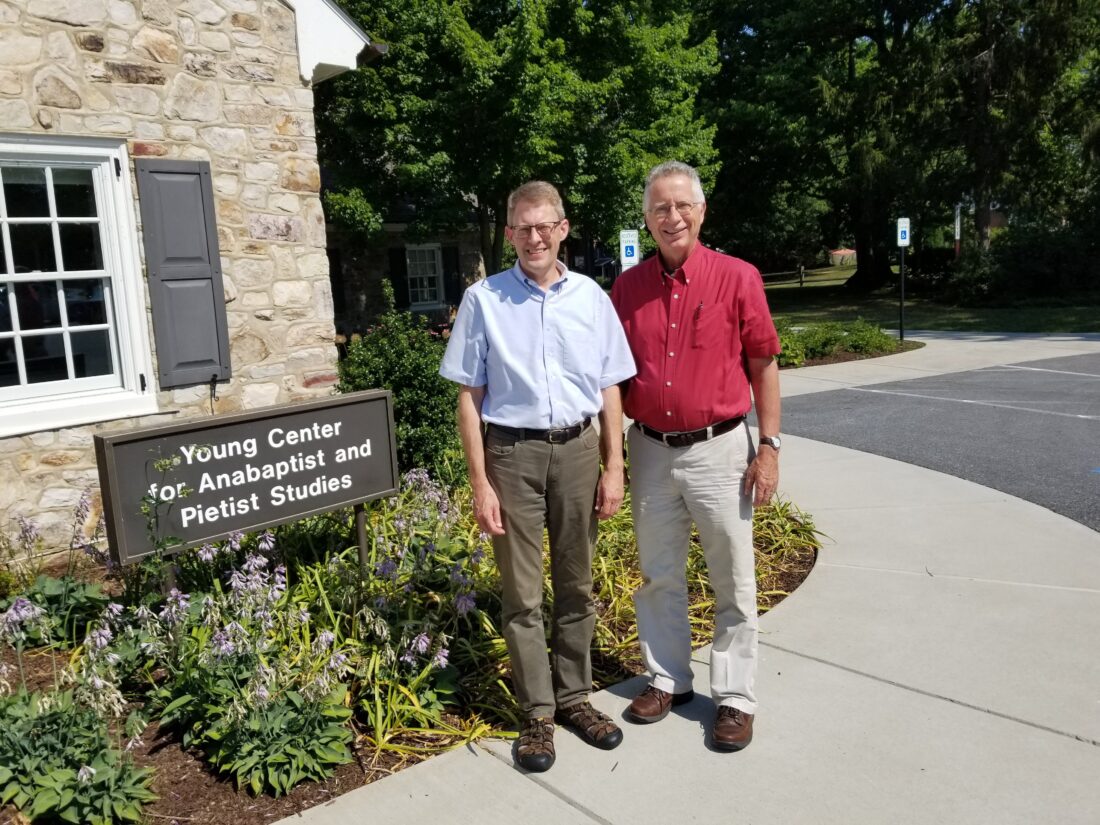
I met Dr. Steve Nolt (left) at Elizabethtown College, Pa., on June 28, 2021, to plan to write a history book about Virginia Mennonites. Steve hosted me at the Young Center for Anabaptist and Pietist Studies.
I try to light a candle in the darkness whenever I can, even in my work. Perhaps especially in my work. The apostle Peter wrote that we’ve been called out of darkness into God’s wonderful light (1 Peter 2:9). So what’s my work, and what’s this light?
My day job is teaching high school students world history and the Bible. Today, I’ll meet 19 bright and eager juniors in AP World History Modern. It’s the most academic driven course I teach, with a national College Board curriculum. In that world history curriculum, I tell stories of saints, missionaries, and those who spoke for the downtrodden and oppressed. Today I’ll tell the story of Bartolome de Las Casas, a 16th-century Dominican friar who worked in the Caribbean, challenging the Spanish government to stop the brutal enslavement of indigenous peoples and slaves.
My work is also to collaborate and work with the faculty at my high school. These are my friends, my cohorts, and colleagues. They encourage me, give me insights, and help me to laugh at kids and life. Recently I was invited to share a Christmas devotional with the entire K-12 faculty and staff at EMS.
This fall, I worked to help bring a little light to a food pantry near Washington, D.C. Capital Christian Fellowship needed more food boxes, and so the National Honor Society students and sponsors, of which I am one, engineered a food drive to fill 80 boxes. It was fun to see them loaded on a pickup truck and driven to the church.
Another element of my ongoing work is to produce a quarterly journal, Shenandoah Mennonite Historian. The next issue features the Show Towel of a young Mennonite bride from Rockingham County, Va., who made a beautiful work of art for her groom to be. The date on the Show Towel is 1826.
My work, flowing out of the apostle Peter’s writing, is to declare the praises of God, who called me out of darkness into his marvelous light.
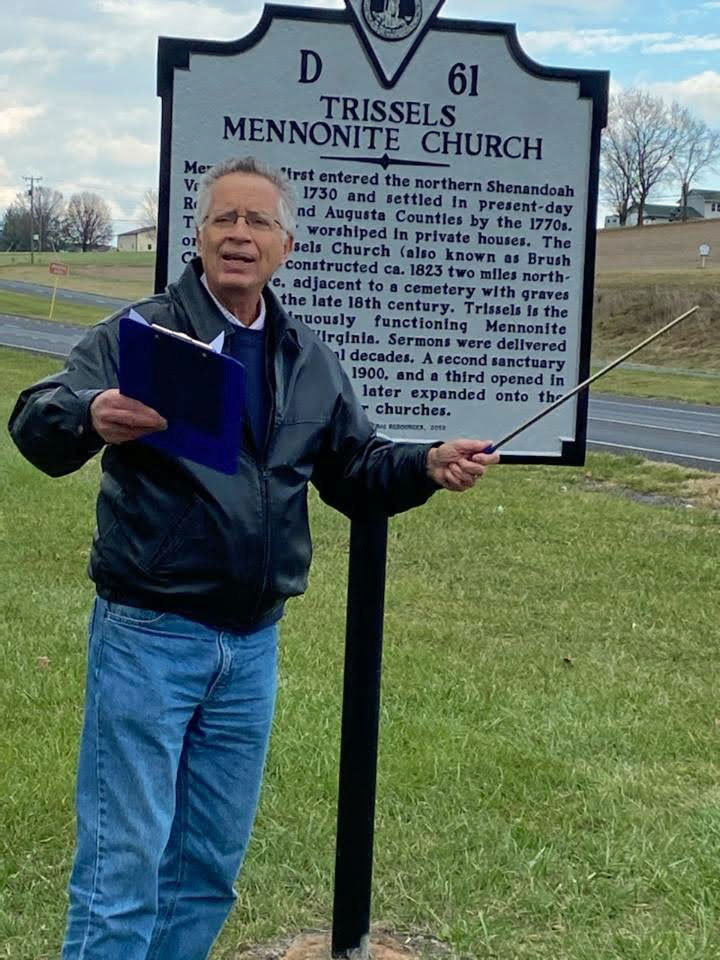
My work includes writing a Trissels Mennonite Church bicentennial history book. I spoke recently at a Virginia State historical marker sign dedication at Trissels Road and Route 42, Rockingham County, Va. Seventh generation descendants of the earliest Mennonite settlers to the Linville Creek attended the event on a blustery Sunday afternoon in November 2020. The sign, describing Trissels’ bicentennial, marks the first in a series of celebratory events over the next two years.
I Can Do This: On my desk is a generous stack of affirmation cards from my students at the end of a difficult semester of online instruction. Without warning, on-campus classes were suspended, and we went online beginning March 17, 2020. For eleven weeks, I taught five courses, with eighty-five students, in a distance learning environment. I can do this new style of instruction.
I Prefer the Classroom: Education that works mostly requires human interaction and dialogue. While I can teach history and Bible classes online, it’s the classroom setting that drew me to the profession in the first place. I much prefer a live classroom setting where I can encourage, direct, and instruct. History is a series of stories that need to be told through a human voice, not the pixels of an idle screen. I much prefer teaching in-person to online.
The Future Will Not be Like the Past: At the end of this semester, June 7, 2020, it is clear that the future of education will not be like it has been in the past. At our school, we are prepared to teach on campus or online, at a moment’s notice. Education at the high school level has changed fundamentally, such that to say we’ll go back to “normal” won’t work. We don’t know what the future holds, but teachers will still be needed, whether online or in cyberspace.
Teaching history and Bible classes at Eastern Mennonite High School, Harrisonburg, Virginia, March 25, 2020
When Naomi Francisco got married in 1956, she did not want to be involved in church or anything religious. She did not want to marry anyone who would preach and be active in the church like her father. After several years of marriage, however, and the birth of three sons, Naomi’s husband stopped drinking alcohol and going to clubs to dance the night away. With her husband’s changed life, the Holy Spirit gave Naomi new purpose to fully support his pastoral ministries.
In 1966, Leslie W. Francisco II received ordination in the Virginia Mennonite Conference. Naomi worked actively with Leslie in a Mennonite church plant in Newport News, Virginia. Naomi taught Sunday school and Vacation Bible School, directed the children’s choir, led prayer meetings and women’s activities, and helped in any way needed in the church.
When Nelson Burkholder stepped aside as minister of Calvary Mennonite Church in 1973, Naomi’s husband became the lead minister of the VMC congregation. The church became charismatic, including speaking in tongues, energetic music, weekly altar calls, and testimonies. The church held street meetings in Newport News and grew in numbers, but Leslie Francisco II developed a vision to plant a church near their home in Hampton, some miles away.
Both in Newport News and then at Calvary Community Church in Hampton, Naomi became the spiritual Mother of the congregation. Whether to her growing Francisco family, or the large crowds that came for weekly worship, Naomi was affectionately known as “Grandma” to some and “Mother” to others. Her sparkling eyes, beautiful smile, bubbly personality, hearty laughter, and generous nature warmed the hearts of many. Naomi encouraged many children in the Calvary Christian Academy that met in the church. She came into their classrooms and offices with special treats and words of wisdom for Christian living.
In 1985, Naomi and Leslie moved their ministries to Hampton and established the Calvary Community Church. After Leslie was ordained bishop in the Warwick District of Virginia Conference, the church planter couple traveled to Ames, Iowa, for the 1985 Mennonite Church General Assembly. There, the Mennonite Board of Missions gave Bishop Leslie and Naomi Francisco the James and Rowena Lark award, for their significant work in evangelism and church development. The mantle of leadership at Calvary Community Church in Hampton passed to Naomi’s son Leslie Francisco III in 1986 when her husband’s health forced him to step aside.
At Naomi’s large funeral service at Calvary on February 12, 2020, Naomi’s granddaughter, Calvary Pastor Lesley Francisco McClendon delivered the message. A host of bishops and ministers attended Naomi’s funeral service. Also in attendance were Hampton officials, including the Hampton Mayor and Hampton Councilman Steven Brown, a former minister at Calvary Community Church.
Naomi Francisco was the co-founder of Calvary Community Church, the matriarch of her community, and loved by many. With regional political officials in attendance at Naomi’s funeral, it is not surprising that the Virginia State Senate passed Resolution No. 39, February 27, 2020, that recognized the accomplishments of Naomi Rowe (Taylor) Francisco.
Naomi R. Francisco (1935-2020) Photo from Calvary Community Church
This article published in Pathways, of Virginia Mennonite Conference, Spring 2020 issue, page 13
One of Brenda (Carr) Fairweather’s
memories of growing up at the Chicago Avenue Mennonite Church is the
refreshments served to children at Vacation Bible School. During Brenda’s
childhood at Chicago Avenue during the 1960s, there were a couple of hundred
kids swelling the ranks of a mission-minded Mennonite congregation in the heart
of Harrisonburg. At break time, Brenda remembers that teachers and staff served
her Kool-Aid and cookies.
Chicago Avenue grew out of the impulse of Eastern
Mennonite School students in the 1930s, the resources of Virginia Mennonite
Board of Missions in the 1940s, and the steady stream of young couples from
Virginia Conference Churches who migrated to the Harrisonburg Church.
Students from the EMS high school and junior college
launched a ministry into Harrisonburg in 1936. Students at the school wondered
why Mennonites were sending missionaries to Africa, but no outreach existed to
black children in Harrisonburg. Though services remained segregated, the school
sent students and faculty to teach Sunday school to children in Harrisonburg.
After meeting in a rented building on Gay Street for
several years, and with numbers increasing, the Virginia Mennonite Board of
Missions purchased a Chicago Avenue building in 1939. Out of the student-led
work in the city, the Mission Board helped fund the start of Broad Street
Mennonite Church and a church on Chicago Avenue.
By 1948 the Mission Board stepped aside as the church
on Chicago Avenue became self-supporting. The bishops of Northern and Middle
Districts both wanted the Chicago Avenue church to be in their districts, and
folks from both Districts attended the new church. When bishops in the Northern
gave way, Chicago Avenue became a Middle District congregation.
The missions’ impulse went out beyond the small
meetinghouse on the corner of Green St. and Chicago Avenue. In the late 1940s,
Ridgeway Mennonite Church, also in Harrisonburg, came to life with folks from
Chicago Avenue. In the early 1950s, others from Chicago Avenue helped establish
Mt. Vernon Mennonite Church in Grottoes, Rockingham County.
Young couples from Conference Churches migrated quickly
to Chicago Avenue in the late 1940s and 50s. Among others, these included
Winston and Phyllis Weaver, Charles and Eula Burkholder, Warren and Virginia
Burkholder, John and Maude Lantz, and Harold and Athalyn Driver. The city
church provided an opportunity to evangelize the unchurched and had more
relaxed standards on dress expectations.
Chicago Avenue Pastor Harold Eshleman married Donna and
Nelson Suter in June 1955. Married at age seventeen, Donna had five children,
and she credits pastor Harold and key women in the congregation for giving her
counsel and support. Chicago Avenue had active outreach ministries, like Sewing
Circle and Vacation Bible School, but folks within the congregation, like Donna
Suter, were also ministered to in life-giving ways.
Chicago Avenue Mennonite Church Vacation Bible School, about 1960, Harrisonburg, Va.
In 1972, bursting at the seams, Chicago Avenue Mennonite Church built a new meetinghouse several miles away and became Harrisonburg Mennonite Church. Others, mainly from EMC, kept the doors open on Chicago Avenue and organized Community Mennonite Church. The church building today is used by another denomination, but fond memories of grape Kool-Aid and sugar cookies still survive.
From the opening hymn sing to the contemporary songs in worship, my heart thrilled to the music at Kansas City 2019. As a delegate and long-time convention-goer, I understand that things have changed for MC USA. Our music, however, is a welcome constant, and it helps to unify and build us up in God’s Spirit. For me, singing in worship with thousands of others provided the highest value in attending the convention.
Our music helped create unity amidst diversity. My cordial table of delegates came from seven states. We were not alike, and we had different perspectives. But when we left our meeting room and joined with three thousand people in the joint worship services, our diversities paled in the glory of praise and honor to God. Let’s sing even more MC USA; it just may help us find a renewed unity that celebrates our theological, cultural, and geographical diversities.
Singing together in the big hall expressed our deepest convictions. When the band started, when the chorister led a time-tested hymn, or when we learned a new song, we confessed lyrics about the most basic beliefs of our faith in God. I am amazed at how poets and musicians can express heart faith in songs that are God-honoring. With rows and rows of high school kids having fun behind me, the singing and clapping energized me even more.
Great convention singing frees our voices in the arts. Our drummer wore a t-shirt that said, in large letters, “The Drummer.” He got into the beat, and the audience loved to watch him do his thing. Our songs at convention ranged from time-tested “Come Thou Fount” to a fantastic break-out medley featuring “Swing Low Sweet Chariot.” Every member of the praise band brought just the right volume, intensity, and rhythm to help free our voices in the God-given wonder of music. Let’s keep emphasizing singing in our churches, conferences, and at the biennial convention.
Our songs at convention helped to unify the generations. This year older attendees sat next to and sang with youth. I liked the joint music and worship services. Years ago, my wife and I sent our three teens to Mennonite Youth Conventions, with thousands of youth in attendance. Our numbers were down this year, compared to earlier years, and I do ponder why attendance at convention has declined from previous years. All the more reason, I think, to emphasize our music. Years ago, at conventions, adults and youth stayed in different auditoriums for their music–an intergenerational belly laugh with three teens after our first day’s joint worship service is one of my highlights from MennoCon19.
I hope great singing stays front and center for future conventions. Leaders in MC USA should find ways to get our people singing, often, and in ways that draw us together. After a discussion at my delegate table left me tense, I shed tears of joy afterward in worship when the praise band broke into the tune “Days of Elijah.” For me, the great music at convention made it worth the time, energy, and money to attend.
"Articulating historical perspectives that inform current trends in the church, society and the world," by Elwood E. Yoder