I try to light a candle in the darkness whenever I can, even in my work. Perhaps especially in my work. The apostle Peter wrote that we’ve been called out of darkness into God’s wonderful light (1 Peter 2:9). So what’s my work, and what’s this light?
My day job is teaching high school students world history and the Bible. Today, I’ll meet 19 bright and eager juniors in AP World History Modern. It’s the most academic driven course I teach, with a national College Board curriculum. In that world history curriculum, I tell stories of saints, missionaries, and those who spoke for the downtrodden and oppressed. Today I’ll tell the story of Bartolome de Las Casas, a 16th-century Dominican friar who worked in the Caribbean, challenging the Spanish government to stop the brutal enslavement of indigenous peoples and slaves.
My work is also to collaborate and work with the faculty at my high school. These are my friends, my cohorts, and colleagues. They encourage me, give me insights, and help me to laugh at kids and life. Recently I was invited to share a Christmas devotional with the entire K-12 faculty and staff at EMS.
This fall, I worked to help bring a little light to a food pantry near Washington, D.C. Capital Christian Fellowship needed more food boxes, and so the National Honor Society students and sponsors, of which I am one, engineered a food drive to fill 80 boxes. It was fun to see them loaded on a pickup truck and driven to the church.
Another element of my ongoing work is to produce a quarterly journal, Shenandoah Mennonite Historian. The next issue features the Show Towel of a young Mennonite bride from Rockingham County, Va., who made a beautiful work of art for her groom to be. The date on the Show Towel is 1826.
My work, flowing out of the apostle Peter’s writing, is to declare the praises of God, who called me out of darkness into his marvelous light.
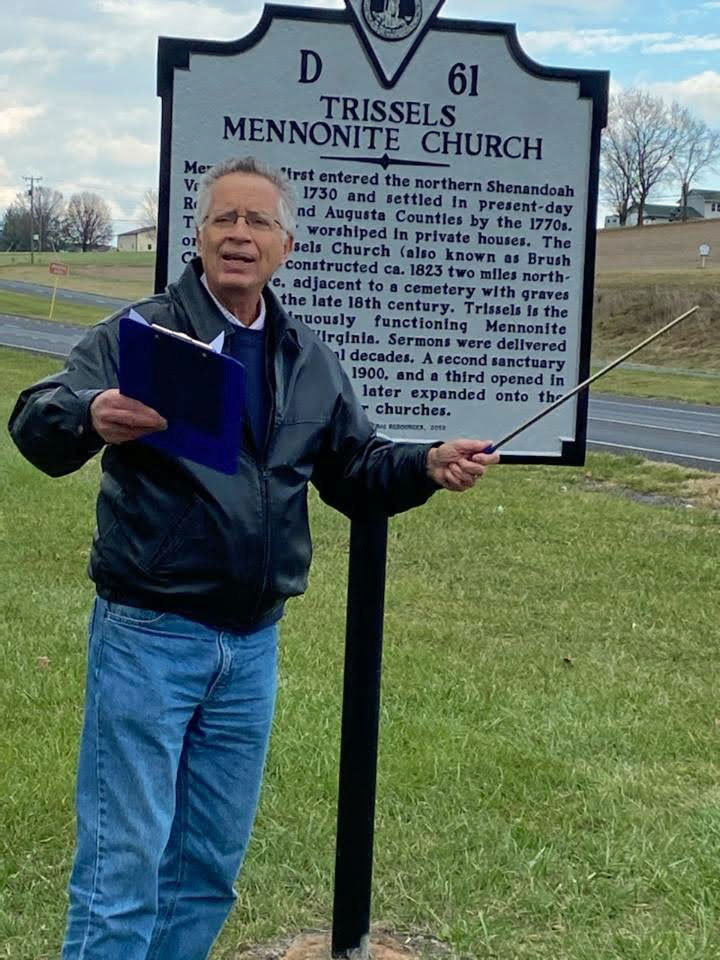
My work includes writing a Trissels Mennonite Church bicentennial history book. I spoke recently at a Virginia State historical marker sign dedication at Trissels Road and Route 42, Rockingham County, Va. Seventh generation descendants of the earliest Mennonite settlers to the Linville Creek attended the event on a blustery Sunday afternoon in November 2020. The sign, describing Trissels’ bicentennial, marks the first in a series of celebratory events over the next two years.
In 1952, Samuel O. Weaver’s high
school English teacher insisted that he learn how to diagram a sentence. Sam saw
no need to learn how to diagram a sentence, and he told A. Grace Wenger, his
EMS teacher, that he intended to return to Newport News and milk cows for his
brother. She replied to Sam that he didn’t know where the Lord would call him
and that he should learn how to diagram a sentence. Sam graduated from high
school, college, and earned a Master’s Degree, though sixty-seven years later,
in a 2019 interview, Sam laughed and admitted that he still does not know how
to diagram a sentence!
In spite of not being able to
diagram a sentence, God used Sam in a mighty way during his twelve years as
principal of EMHS, 1969-1981. A. Grace Wenger was right—Sam didn’t know where
God would lead him or in what capacity he would serve the church. It was in the
late 1960s that Sam was called to lead Eastern Mennonite High School as it
sought to become independent from Eastern Mennonite College.
Dr. Myron Augsburger, President of
EMC, needed a high school principal with financial and marketing skills. So he
hired Sam Weaver to head the high school in 1969. To lead the high school, Sam needed
training in education, and he enrolled in a Master’s program at James Madison
University. In the meantime, Weaver relied on dependable teachers already
working at EMHS, like James Rush, David Mumaw, Lois Janzen, Harvey Yoder,
Marvin Miller, Ron Koppenhaver, Gloria Lehman, Esther Augsburger, Sam Strong, and
Vivian Beachy. In 1977, Sam hired Ernest Martin to develop the academic program
at the school. Knowing little about academics, Sam acknowledges that “Ernie
saved my hide,” by establishing increased trust and reputation in the community
for curriculum at the high school.
Sam Weaver and Dorothy Shank 2019 EMHS (Andrea Wenger photo)
In the fifteen-year process of
creating an independent high school, Dorothy Shank ably chaired the EMHS Board,
1974-1981. In an era when few women served as leaders in the Mennonite church,
Dorothy prayed about the decision, and then said she would help the school as
the first woman chair of the Board. It was Dorothy, in an interview, who stated
that we all stand on someone else’s shoulders and that it is important to
recognize God’s faithfulness in launching a strong and independent EMHS in the
1970s.
Eastern Mennonite School began as a
high school in 1917, but it soon added junior college classes. When the junior
college grew into a four-year program and earned accreditation in 1947, it
created an identity problem for the high school. By the early 1960s, with
enrollment growth in the college, visionaries in Virginia Mennonite Conference
got busy and built a separate building for the high school in Park View, first
used in 1964. Over Christmas break in 1963-1964, students and teachers picked
up books from the college library and moved them to the new high school campus
nearby on Parkwood Drive.
A few years after the high school
moved into its new building, the EMC Board wanted the high school division to
support itself, and according to the college’s business office, EMHS was
operating at a deficit. In 1967, according to EMC accounting methods, the high
school deficit was over $69,000. The Executive Committee of the EMC Trustees,
which presided over the high school, asked the high school to balance its
budget within five years. With Sam Weaver at the helm of the high school, the
school reached a balanced budget by 1973. While Sam was the Principal, he gives
credit to people like Daniel Bender, Dwight Wyse, Shirley J. Yoder, and Glendon
Blosser for helping to set the financial ship of the school in good standing.
The years of Sam Weaver’s
leadership at EMHS, 1969-1981, were tumultuous years in the United States, with
the Vietnam War, an era of rebellion and protest for youth, and rising
inflation driven by rising oil prices. Still, students kept coming to EMHS,
from as far away as Pigeon, Michigan, Sarasota, Florida, the Tidewater region
of Virginia, and northeast Ohio. By 1977 the high school had 277 students, with
a waiting list. Sam’s Christian education philosophy relies on ownership of a
student’s education from the home, the church, and the Christian school.
Students tested Sam’s leadership, to be sure, but the school grew in many ways
and earned its charter in 1982.
Dorothy Shank remembers that during
her tenure as Board Chair in the late 1970s she worried when good teachers left
EMHS for other positions. She prayed God would send the school good replacement
teachers. She especially worried when Marvin Miller, an outstanding music
teacher, 1966-1981, left EMHS. “But,” Dorothy rejoiced in the interview, “God
brought in Jay Hartzler,” another exceptional music teacher.
In a 2019 interview with Sam Weaver
and Dorothy Shank, they noted the excellent support for the high school from
Virginia Mennonite Conference churches in the 1970s. Sam visited Districts and
churches and encouraged support. Consequently, churches in Virginia Conference
stepped up and supported their high school, through a Congregational Aid Plan
formulated by Glendon Blosser. Sam notes the way Conference Districts sent
delegates to the Board meetings, like Robert Mast from Chesapeake, Va., and Ike
Oberholtzer from Newport News. In return, the EMHS Touring Choir began a spring
circuit of singing in many of the supporting churches, leading them in worship
and song.
Programs and buildings seemed to
spring up in the 1970s, attracting many students to attend. The school built a
new fine arts addition in 1972, and while Dorothy Shank served as Board Chair,
the school added a gymnasium, finished in 1976. In Park School, a former public
school located next door to the high school that EMHS used as early as the
1960s, the high school set up an Industrial Arts program and Art program. The
college set aside rooms for high school students in Maplewood dorm, and to the
present has not charged for the use of Lehman Auditorium for the annual high
school graduation.
Dorothy Shank remembers that the
tone of moving toward separation was tense at times, but by 1982 the two
schools went different directions on amicable terms. And Sam Weaver, the
balding principal who established the financial and church-based foundations
for the school, decided it was time for him to move on. In 2019, an EMHS faculty
member publicly recognized Sam at the annual National Honor Society Induction,
when his granddaughter, Julie Weaver, joined the society. As Principal during
the 1970s, Sam had signed all of the Honor Society documents.
It is not by our power, as Dorothy
asserted, but by God’s grace and faithfulness, that EMHS moved toward
independence from the college in the 1970s. There had been those at the college
who entertained ideas on what to do with the building should the program be
discontinued. With good leadership, EMHS became a viable church school, a
process that began in the 1960s and culminated with a charter in 1982.
What does a letter buried in an Indiana archive have to do
with questions about staying in Mennonite Church USA today? Quite a bit, I’d
argue. The letter, which I found in our denominational archives eight years
ago, reveals that some of the earliest Virginia Mennonite leaders believed in
the value of a church-wide association of congregations. Upon finding the
letter, I had a little party of one by the copying machine in the lobby. Since
then, I’ve discovered more stories confirming that in each era, Virginia
leaders have spoken for, written about, and defended the value of staying with
the denomination. Please consider these brief vignettes that I think provide
significant direction for today.
1853: That thin
and yellowed letter in the Indiana archive came from the pen of Virginia
Mennonite Bishop Martin Burkholder. Thirty-six, he wrote a letter to a
Pennsylvania Bishop friend, and asked that he and other ministers in Lancaster
Conference consider helping him create a general conference of Mennonites. Burkholder
and Bishop Samuel Shank Sr. made several circuit trips to Pennsylvania, Ohio,
New York, and Canada, asking for a general conference to be formed, but to no
avail. After Bishop Martin Burkholder passed away a few months before the Civil
War began, it would be decades until his vision for a Mennonite association of
area conferences came into being. The great irony of my search in libraries and
archives along the east coast, and then finding the letter in Indiana, 157
years after it was written in the Shenandoah Valley, is that having a national archive
is one outstanding rationale for staying with a denomination long term.
1897: A year
before the Mennonite Church got organized in 1898, Virginia Bishop Lewis J.
Heatwole traveled to Elida, Ohio, for preliminary meetings. He and other
ministers like Christian Good and Samuel M. Burkholder went to see what was
happening, and to report back to leaders in Virginia. L. J. Heatwole faithfully
traveled to the early meetings of the Mennonite Church, and kept Virginia
Conference informed about wider church developments. With L. J. Heatwole’s
clear leadership toward participating, Virginia Conference joined the Mennonite
General Conference in 1911.
1919: When
Virginia Mennonite Conference met a year after World War I ended, it adopted
eighteen fundamentals of faith. Conservative in nature, the articles were
adopted, almost word for word, two years later by the Mennonite Church.
Virginia Conference’s action, adopted at my home congregation in Broadway,
Virginia, October 18, 1919, held significant influence and sway on the
Mennonite Church for nearly two generations.
1942: When
critical ministers urged Virginia Conference to leave the Mennonite Church
during WWII, Bishop John L. Stauffer reacted strongly. Though some thought the
broader church had become too liberal, Stauffer stated that Virginia needed to
stay and not leave. Bishop Stauffer, then President of Eastern Mennonite
College, had significant church wide experience, and he urged the Conference to
stay in the denomination. Stauffer’s voice, along with others, won the day.
1981: Ruth
Brunk Stoltzfus waited patiently to speak at the Mennonite Church Convention in
Bowling Green, Ohio. The hot topic was whether women could be involved in
ministry. Her speech at an open microphone stirred many, and helped to create
action in the direction of accepting women in leadership. Virginia Bishop
Glendon Blosser ably and gladly served as Moderator at the 1981 Bowling Green
Conference, the seventh of eleven Virginia Mennonite leaders to serve as moderator
of the denomination.
1997: My wife
and I took our family to Orlando, Florida, for the Mennonite Church General
Assembly in the summer of 1997. While our three young children enjoyed the fun
times for kids and we soaked up the Florida warmth, I served as a delegate from
Virginia Conference. We took our kids to Disneyland after the Mennonite Church
made proactive plans to integrate with the General Conference. Owen Burkholder,
from Harrisonburg, served in 1997 as both denominational moderator and as
Virginia Conference minister, the lead executive staff position.
2019: Today’s issues are different than in the past, but in other ways quite similar. I teach history and Bible to descendants of Bishop Martin Burkholder, whose letter I found in Indiana. I try to help them understand the high value their ancestor held in organizing a general conference. Further, I will take a bit of Bishop Burkholder’s spirited vision with me when I serve as a delegate at the 2019 Mennonite Church USA Convention in Kansas City. My reading of Virginia Mennonite Conference history is that at each turn in the road of divisive issues, key leaders in Virginia Conference have spoken in favor of participation in the wider denomination. Such is the direction I would urge today.
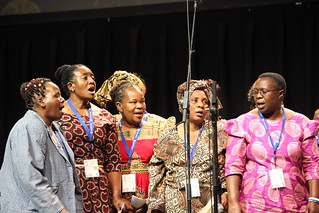
Pennsylvania 2015 brought together over 7000 Anabaptists from around the world, representing some 80 countries. Worship was inspiring and the speakers spoke of their lives in the global south. The Brethren Choral Sounds Choir from Zimbabwe (pictured) thrilled the audience with their lively and energetic music. Nearly five centuries later, from their early 16h century origins in Switzerland, Mennonites are now a global people speaking many different languages, but testifying to a common faith in God.
It was a pleasure to stay with a Bluffton University host family at an 1852 farm house located on a Nature Reserve connected with the Ohio school. The historic house was built by the earliest Swiss Mennonite settlers to the west-central Ohio community. The historian saw geese, deer tracks, and signs of abundant wildlife, perhaps much like the way it was when the Mennonites migrated to the region decades ago.
The Historian attended a workshop on DACS, an archival content standard for archives and libraries, at the Lancaster Mennonite Historical Society, March, 2014. Traffic on the busy Lincoln Highway rushes past important historic records in the nearby archives that remind one of an earlier era, before tour buses, harried shoppers, and commercialism changed the idyllic Lancaster farmland.
The Information Superhighway has changed schools. In the 1970s high schools had books, magazines, and traditional libraries. Today students can access a world of resources on computers in their classrooms. The Kennel Charles Church History desk (right), with Martyrs Mirror on the top shelf, hosts a state-of-the-art computer that brings information to the student in the history teacher’s classroom at Eastern Mennonite High School, Harrisonburg, Virginia.
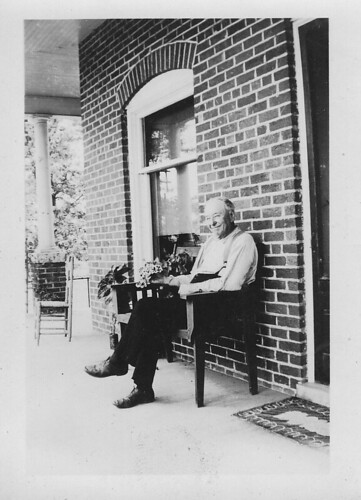
The Historian discovered this rare photo of the Bishop in the Archives the other day. This photo was a total surprise. The only other photo of Bishop Shank is a grainy uncomplimentary photo. Nice to see a better photo.
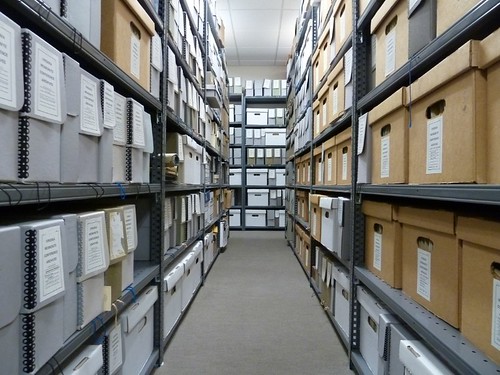
A hundred and seventy-five years worth of materials are stored in these archives. Like a detective, the historian searches through these boxes for the stuff of history: letters, journals, diaries, receipts, advertisements, photos, and scrapbooks.
In 2001, the good folks at Crest Hill Mennonite Church, Wardensville, West Virginia, invited a group of gospel bluegrass musicians to their church for an outdoor summer performance. The church invited Daphna Creek band in 2002 and 2003, the last performance during Sunday morning worship. Daphna Creek went on to play in over 200 venues, but the first show was at this church in West Virginia.
"Articulating historical perspectives that inform current trends in the church, society and the world," by Elwood E. Yoder