An Amish buggy clips along on Hobson Road, Lancaster County, Pennsylvania, March 8, 2014. The triangle caution sign on the rear of the buggy warns automobile drivers of a slow-moving vehicle ahead.

An Amish buggy clips along on Hobson Road, Lancaster County, Pennsylvania, March 8, 2014. The triangle caution sign on the rear of the buggy warns automobile drivers of a slow-moving vehicle ahead.
This Amish schoolhouse in Lancaster County, Pennsylvania, hosts children from the Amish families in the surrounding community. The outdoor toilets, fences that reveal the boundaries with the fields nearby, and the bell atop the school are indicative of an earlier era of education. The teacher and children come on foot, sled, or sleigh, and are rarely stopped by snow or inclement conditions. Most will finish their education around the 8th grade.

The Information Superhighway has changed schools. In the 1970s high schools had books, magazines, and traditional libraries. Today students can access a world of resources on computers in their classrooms. The Kennel Charles Church History desk (right), with Martyrs Mirror on the top shelf, hosts a state-of-the-art computer that brings information to the student in the history teacher’s classroom at Eastern Mennonite High School, Harrisonburg, Virginia.

New bridge over Linville Creek replaces 1898 wrought iron truss bridge that many Broadway, Virginia, residents, including Mennonites, used in early 20th century, a photo by MennoniteArchivesofVirginia on Flickr.
Mennonites in the Northern District of Virginia Mennonite Conference often used this old iron bridge to head west towards mission stations in the West Virginia highlands. Today a modern bridge over the steady Linville Creek reduces the 1898 bridge to a foot and bike path. The old bridge in Broadway, Virginia, is on the National Register of Historic Places in Virginia.
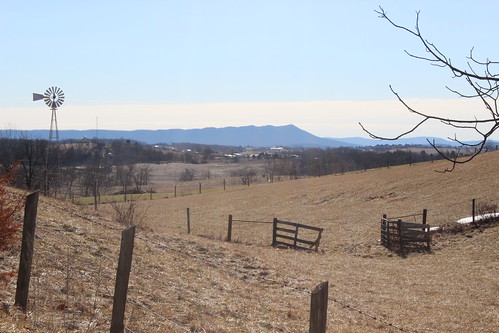
On a trip from Singers Glen, Virginia, to Harrisonburg, Virginia, the historian spotted this grand view of the Massanutten Mountain. On his trips to Harrisonburg, musician Joseph Funk probably paused to relish in the ancient beauty of the distant mountain peak. Perhaps it was inspiration for his printing and musical work in the valley.

Mole Hill rises out of the horizon (left middle) when viewed from the western region of Rockingham County, Virginia, January, 2014. Mennonite farms, along with others in the region dot the winter landscape in the distance beyond a Saturday morning funeral that brought a thunderstorm to the attenders.
In the late 17th century Amish began migrating from Europe to Philadelphia, PA, and eventually moved west to Lancaster County, PA. From there they migrated west to Ohio and other states. In Lancaster County, the Amish maintain their agricultural way of of life, in spite of rapid urbanization and modernity all around them. They are the fastest growing religious group in North America. This Amish farm is in Smoketown, Lancaster County, PA.

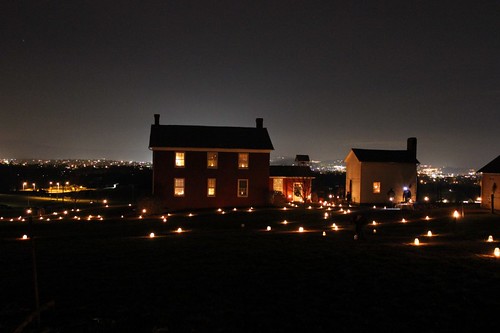
Christmas on a cold December evening at the historic 1854 Burkholder-Myers house in Harrisonburg, Virginia, with twenty-first century lights and a football field in the distance. Martin and Rebecca Burkholder would find it a challenge to recognize their own house.

Mountains in the George Washington National Forest to the west of Natural Chimneys, Mt. Solon, Virginia, are ancient, rugged, and beautiful. They reflect the historic grandeur and inspiring views seen regularly by travelers in the Shenandoah Valley of Virginia.

The Historian found this small poster taped to the shelves in the Virginia Mennonite Conference Archives, Harrisonburg, Virginia. May we never be indifferent to our past.