A hundred and seventy-five years worth of materials are stored in these archives. Like a detective, the historian searches through these boxes for the stuff of history: letters, journals, diaries, receipts, advertisements, photos, and scrapbooks.
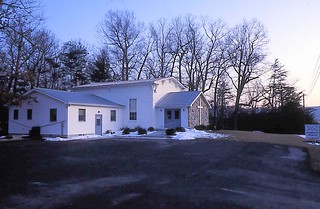
In 2001, the good folks at Crest Hill Mennonite Church, Wardensville, West Virginia, invited a group of gospel bluegrass musicians to their church for an outdoor summer performance. The church invited Daphna Creek band in 2002 and 2003, the last performance during Sunday morning worship. Daphna Creek went on to play in over 200 venues, but the first show was at this church in West Virginia.
Mennonites migrated into the Shenandoah Valley as early as the 1730s, though not until after the Revolutionary War did the trickle turn into a steady migration from points north. Most 18th century Mennonites farmed, whereas in the twentieth century many diversified their economic pursuits into other areas of work. The farming heritage in the western part of Rockingham County near Clover Hill, Virginia, with the Allegheny Mountains as a backdrop, is still strong and deep.
Mennonite Bishop Lewis J. Heatwole wrote an article for the Daily News Record, Harrisonburg, Virginia, in 1921, in which he explained the meaning of the word Massanutten. From his research he concluded that Massanutten is from two Indian words for “ground” and “potato,” which when put together mean “Potato Ground.” Today the old peak still towers over the valley, easily seen from a jumbo jet descending on a Washington, D.C. airport from the south, and visible from about any point in the Shenandoah Valley. The encroachments of civilization have not dimmed the spectacle and grandeur of a mountain that has provided a visual feast for ancient Indians and modern travelers.
Historians met at Mennonite Church USA Convention in Phoenix Arizona. It’s clear there’s a new era of regional collaboration among Mennonite historians rather than the former centralization of historical resources in one place. The Historian sat next to Jake Buhler, President of the Mennonite Historical Society of Saskatchewan, Canada. He shared stories about Russian Mennonites and in turn he heard stories of Swiss-South German Mennonites in Virginia. Buhler and others publish the Saskatchewan Mennonite Historian periodical, similar in name and format to the Shenandoah Mennonite Historian of Virginia.
Mennonites met in Phoenix, Arizona, in early July, 2013, for their biennial convention. A sign at a Vietnamese restaurant welcomed visitors from Virginia and beyond to good food, friendly greetings, and sweltering heat in the downtown area. The Historian has several meetings focused on historical studies to attend at the convention.
Laban Peachey served as President of Hesston College from 1968-1980. Today the Historian drove by an educational center at Hesston College named in his honor. Peachey lives in Harrisonburg, Virginia, and has long been involved in productive and positive church activities.
The Historian had a very nice visit in the Archives and Mennonite Library at Bluffton University, Bluffton, Ohio. The librarians were friendly, the archives are well-kept, and books written by Historian Elmer S. Yoder from northeast Ohio were soon located on the shelves.
Menno Simons sports a baseball cap on a bust in a plaza at Bluffton University, Bluffton, Ohio, as seen by the Historian at a one day technology conference. Would Menno have launched his own blog?
Joseph Funk’s Harmonia Sacra, his print shop, and his progressive attitudes towards church music made Singers Glen the genesis of four part singing for Mennonites and good music throughout the United States. Funk deserves this sign.
"Articulating historical perspectives that inform current trends in the church, society and the world," by Elwood E. Yoder